

Choosing the right lamp for your projector is crucial for ensuring optimal image quality and longevity. This comparison will help you understand the different options available, such as laser, LED, and UHP technologies, and make an informed choice based on your specific needs. We’ll examine the advantages and disadvantages of each lamp type, lifespan, brightness, and other key factors to maximize your investment.
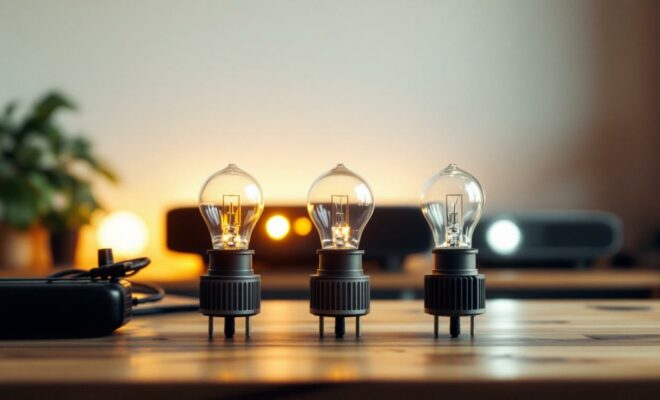
Projector lamp technologies: a detailed comparison
Choosing the right lamp for your video projector is a decision that depends on many variables. The most common types are laser, LED, and UHP (Ultra High Performance) lamps. Each has its own characteristics that can influence your decision, depending on the intended use and the environments where you will be using your device. For some, the extended lifespan of laser lamps, up to 30,000 hours, is a major advantage. Others will prioritize the low energy consumption of LEDs.
The UHP option, on the other hand, stands out for its affordability and ability to offer high brightness, ideal for presentations in well-lit conference rooms.
Advantages and disadvantages of laser lamps
Laser lamps are renowned for their efficiency and longevity. They offer exceptional brightness and contrast, reaching their full potential in just seconds after startup. However, they are often more expensive than other technologies, and in some cases, the cooling system can generate noise.
Understanding the impact of LED technology on energy savings
LED lamps, with a lifespan of approximately 20,000 hours, are a popular alternative for those looking to reduce their energy consumption. They are also silent thanks to the absence of an active cooling system, making them ideal for environments such as home theaters. However, their brightness may be limited in particularly well-lit spaces.
Applications of LEDs in video projectors
The use of LED technology in video projectors is particularly well-suited to intimate or dimly lit environments. The low heat emitted promotes a longer lifespan and requires minimal maintenance. These devices are often compact, making them easy to install in confined spaces.
Performance and affordability of UHP lamps
UHP lamps have long dominated the home and professional projector market thanks to their high brightness and affordability. Although they have a shorter lifespan, typically between 2,000 and 6,000 hours, they remain a viable option for those on a budget.
Financial aspects and strategic choices
UHP lamps offer an attractive compromise for those seeking an affordable solution while still providing sufficient brightness for a variety of environments. However, the financial aspect should not be overlooked, as frequent replacements can be costly in the long run.
Choosing the lamp according to its use and compatibility
The compatibility of the lamp with the projector model, as well as the intended use, are key factors. For example, for use in classrooms or offices, the high brightness levels of UHP lamps are often necessary. For a home theater, an LED may be more suitable due to its quiet operation.
| Lamp type | Lifetime | Brightness | Cost |
| Laser | 20,000 – 30,000 hours | High | Pupil |
| LED | Up to 20,000 hours | Average | Reduced |
| UHP | 2,000 – 6,000 hours | High | Moderate |
Practical considerations for choosing a lamp
In addition to lifespan and brightness, cost and maintenance play a role in the choice. LED and laser lamps require less frequent replacement, while UHP lamps may require recurring repairs and replacements.
Which lamp offers the best image quality?
Laser lamps generally offer the best image quality thanks to their high contrast and constant brightness.
What are the cost differences between video projector lamps?
Laser lamps are often the most expensive, followed by LEDs, while UHP lamps are the least expensive to purchase initially.
How does compatibility affect the choice of lamp?
It is crucial to check that the chosen lamp is compatible with your video projector model to ensure optimal performance.

